Light Is the Loudest Signal Your Body Clock Gets
Dovy Paukstys
Founder, Komori Care
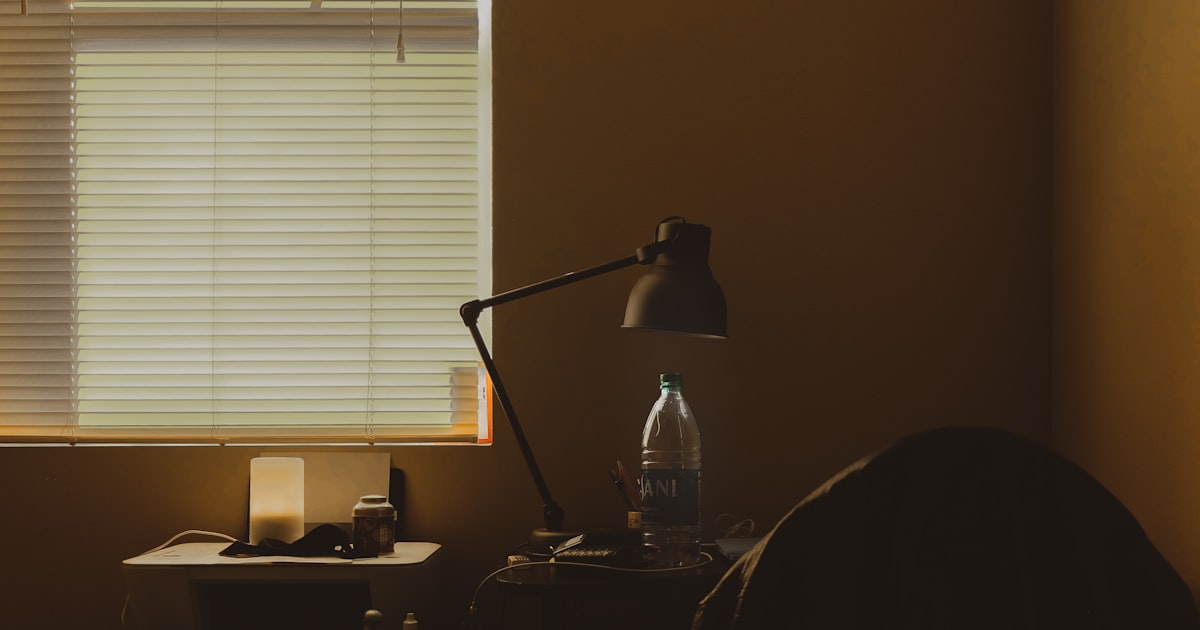
Your Living Room Is Basically a Cave
Almost every article about light and sleep tells you the same three things. Get morning light. Avoid blue light at night. Maybe buy a lamp.
Almost none of them give you a number. That's the problem, because without numbers you have no way to tell that the "bright" room you're sitting in right now is closer, in your body's terms, to darkness than to daytime.
So here are the numbers. A well-lit office runs around 500 lux, and often less [^1]. A typical living room in the evening measures about 30 lux [^2]. An overcast day outside, the kind where you'd say "there's no sun today," runs 1,000 to 30,000 lux [^3].
That's a gap of roughly 30 to 1,000 times. On the gray day. In the shade of clouds. Your eyes lie to you about this, because they adjust so well you never notice. Your body clock does not adjust. It just reads the level and decides what time it is.
Key Facts
- Overcast daylight outdoors: 1,000 to 30,000 lux. Living room in the evening: about 30 lux (Daylighting Pattern Guide; Brown et al., 2022)
- Room light under 200 lux before bed cut melatonin levels by 71% and shortened melatonin release by about 90 minutes (Gooley et al., 2011)
- Around 100 lux — dim room light — already produces half the maximum clock shift that 9,000 lux of bright light does (Zeitzer et al., 2000)
- Light before your body's temperature low pushes your clock later; light after it pulls your clock earlier (Khalsa et al., 2003)
- The clock-setting cells make up only 0.3 to 0.8% of the nerve cells leaving your retina (Lax et al., 2019)
- Expert recommendation: at least 250 melanopic lux during the day, under 10 in the evening, under 1 while asleep (Brown et al., 2022)
Want a follow-up on this topic? Get a note when Komori launches (2027)
One email when the contactless monitor ships, plus the occasional short follow-up on this topic. No spam, leave any time.
Two Units, Explained Once
Lux is how much light lands on a surface. Point a light meter at your face and it tells you lux. Higher number, brighter.
Melanopic EDI is the newer one, and it's the one researchers now use for body-clock work. It's still measured in lux, but it's weighted for the specific kind of light your clock actually reacts to, which sits toward the blue end of the spectrum. Two lamps can read the same in ordinary lux and be very different in melanopic lux, because one is warmer and one is bluer.
When you see "250 melanopic lux," read it as "enough of the right kind of light for your body to be confident it's daytime."
The Table Nobody Prints
| Situation | Roughly how bright | Source |
|---|---|---|
| Direct summer sun | up to 100,000 lux | 1 |
| Bright daylight, out of direct sun | about 25,000 lux | 1 |
| Overcast day, outdoors | 1,000 to 30,000 lux | 2 |
| Well-lit office | about 500 lux, often less | 1 |
| Office lighting as your eyes see it, vertically | usually under 200 melanopic lux | 3 |
| Living room, evening | about 30 lux | 3 |
| Phone or laptop screen in a dark room | over 60 melanopic lux | 3 |
| Full moon | about 0.2 lux | 4 |
| Starlight, no moon | about 0.001 lux | 4 |
Look at the middle of that table. Indoor life sits in a band from roughly 30 to 500 lux, all day, every day. Outdoor life at its dimmest starts around 1,000. We are living inside a permanent, mild twilight and wondering why our sleep feels vague.
The Cells Doing This Have Almost Nothing to Do With Seeing
Here's the part that surprises people. Your clock isn't reading light through the cells you see with.
Your retina has a small, separate population of light-sensing cells called intrinsically photosensitive retinal ganglion cells — ipRGCs. "Intrinsically photosensitive" just means they detect light on their own, without help from the rods and cones that produce vision. They contain a pigment called melanopsin, which is what makes them sensitive to light in the first place.
They are rare. They make up only 0.3 to 0.8% of all the nerve cells leaving your retina 5. And they don't send their signal to the visual part of your brain. They run to the suprachiasmatic nucleus, the small cluster of cells in the hypothalamus that acts as your master clock 5.
So there's a dedicated wire from your eyes to your clock, staffed by fewer than one cell in a hundred, and it's largely reading overall brightness rather than shapes. That's why light works on sleep even when you're not paying any attention to it, and why "I feel fine, the room isn't that bright" is not evidence of anything.
This is also why blind spots in the advice matter. Sunglasses on your morning walk cut the signal. So does staying inside by a window, since indoor light lands in that dim 30-to-500 band no matter how sunny it looks out there. The wire doesn't care about your intentions.
Same Light, Opposite Effects, Depending on When
The single most useful fact about light and sleep is that the same light does opposite things at different times of day.
Researchers map this with a phase response curve, which is just a graph of "light at this hour shifts your clock this much, in this direction." Khalsa and colleagues built one of the cleanest versions in 21 people using long bright-light exposures 6.
What they found:
- Light hitting before your body's lowest core temperature point — which lands in the late night for most people — delays your clock, pushing sleep later. The biggest delay they measured was about 3.6 hours.
- Light hitting after that point, in the early morning, advances your clock, pulling sleep earlier. The biggest advance was about 2 hours.
- The full range from maximum delay to maximum advance was 5 hours 6.
Two practical consequences fall out of this.
Morning light is the lever for anyone who can't fall asleep at a reasonable hour. If your body wants to sleep at 2 AM, evening habits are not the main fix. Light shortly after you wake is. The reason this works comes down to what circadian phase actually is and how it differs from your alarm-clock schedule — we covered the schedule versus body clock distinction separately.
Evening light is the lever pulling in the wrong direction. Every hour of bright indoor light after dinner is a small vote for "it's still daytime, stay up." If you regularly take forever to fall asleep, this is one of the first places to look.
The same curve is why crossing time zones scrambles you, and why the timing of light exposure matters more than the amount when you're recovering from jet lag.
How Little Light It Takes to Shut Melatonin Down
Melatonin is the hormone your brain releases in the evening to mark biological night. Light suppresses it. The question is how much light.
The answer is: much less than you'd think.
Zeitzer and colleagues exposed 23 people to a range of light levels in the early biological night. Around 100 lux — ordinary dim room light — produced about half of the maximum clock shift that roughly 9,000 lux of bright light produced 7. Half the effect from about one percent of the light. The response saturates fast, which means the first little bit of light does most of the damage.
Gooley and colleagues then tested it in a more realistic setting with 116 people. Exposure to ordinary room light under 200 lux, from the start of melatonin release until bedtime, cut melatonin levels by 71.4% compared with dim light, and shortened the total window of melatonin release by about 90 minutes 8.
Under 200 lux. That is a normal, unremarkable, nobody-would-call-it-bright living room with the overhead on.
This is the honest version of the "blue light" conversation. It was never mainly about your phone. Your phone matters — a screen in a dark room can deliver over 60 melanopic lux on its own 3 — but the ceiling fixture above your head is usually the bigger source, and nobody sells a filter for that.
What To Actually Do
The 2022 consensus recommendations from a group of circadian researchers are refreshingly concrete. During the day, aim for at least 250 melanopic lux at eye level. Starting three hours before bed, keep it under 10 melanopic lux. While sleeping, under 1 lux 3.
Translated into things you can do this week:
Go outside in the morning. The paper says it directly: daylight should be the first choice for meeting daytime levels 3. Ten or fifteen minutes outdoors beats an hour indoors near a window, because indoors is still indoor-level light. Cloudy is fine. Cloudy is still 1,000-plus lux.
Stop treating "I sit near a window" as a plan. Standard office lighting delivers under 200 melanopic lux at eye level even when it meets the workplace standard for seeing your desk 3. Meeting the standard for reading is not the same as meeting the standard for your clock.
Get the overhead lights down after dinner, not just the screens. One or two warm lamps at hip or table height beats a bright ceiling. This costs nothing.
Make the bedroom actually dark. Under 1 lux is dark enough that you can't read by it. Standby LEDs, streetlight through thin curtains, and a bright clock face all count. That's a piece of the bedroom setup that people skip because it feels trivial.
The Opinion Part
Most of what gets sold for light and sleep is solving the wrong end of the problem.
Blue-blocking glasses, screen filters, and warm display modes address evening light, which is real but is the smaller half. The bigger half is that your daytime is too dark, and no product fixes that as well as a door does.
A ten-thousand-lux therapy lamp is a legitimate tool, and for people with genuine circadian disorders or dark northern winters it's the right call. But it exists to substitute for the sun. If the sun is available and you're not using it, buying the substitute first is an odd order of operations.
Free, outdoors, in the first hour or two after you wake. Everything else on the list is optional next to that.
Where Komori Fits
Komori is a wellness device. It is not designed to detect, diagnose, or treat any condition, and it does not measure your body's clock.
Among the room conditions it's being built to log, contactlessly and with no camera, is ambient light in the bedroom, alongside temperature, humidity, sound, and your movement and sleep position through the night.
The reason light belongs on that list is the 1-lux recommendation above. It's the one number in this post that's easy to be wrong about, because your eyes adapt within a minute of the lights going out and the room stops feeling bright. Once it ships, someone might find that the room they thought was dark isn't, or that their restless stretches line up with the hours a streetlight hits the window. That's a pattern worth seeing. It isn't a diagnosis, and it isn't meant to be one.
The Short Version
Light is the strongest input your clock has. Your daytime is probably too dim by a factor of ten or more, your evening is brighter than it needs to be, and your bedroom is probably not as dark as you think.
Fix the daytime first. Go outside tomorrow morning, before you change anything else. If sleep stays broken after a few weeks of that, it's worth raising with your doctor, because persistent trouble sleeping usually has more than one cause. Other timing factors that affect sleep quality include when you stop caffeine and evening exercise timing.
Footnotes
-
Blume C, Garbazza C, Spitschan M. "Effects of light on human circadian rhythms, sleep and mood." Somnologie, 2019. ↩ ↩2 ↩3
-
New Buildings Institute. "LUX: Overcast Sky." Daylighting Pattern Guide. ↩
-
Brown TM, Brainard GC, Cajochen C, et al. "Recommendations for daytime, evening, and nighttime indoor light exposure to best support physiology, sleep, and wakefulness in healthy adults." PLOS Biology, 2022. ↩ ↩2 ↩3 ↩4 ↩5 ↩6 ↩7
-
Spitschan M, Aguirre GK, Brainard DH, Sweeney AM. "Variation of outdoor illumination as a function of solar elevation and light pollution." Scientific Reports, 2016. ↩ ↩2
-
Lax P, Ortuño-Lizarán I, Maneu V, Vidal-Sanz M, Cuenca N. "Photosensitive Melanopsin-Containing Retinal Ganglion Cells in Health and Disease: Implications for Circadian Rhythms." International Journal of Molecular Sciences, 2019. ↩ ↩2
-
Khalsa SBS, Jewett ME, Cajochen C, Czeisler CA. "A phase response curve to single bright light pulses in human subjects." The Journal of Physiology, 2003. ↩ ↩2
-
Zeitzer JM, Dijk DJ, Kronauer RE, Brown EN, Czeisler CA. "Sensitivity of the human circadian pacemaker to nocturnal light: melatonin phase resetting and suppression." The Journal of Physiology, 2000. ↩
-
Gooley JJ, Chamberlain K, Smith KA, et al. "Exposure to room light before bedtime suppresses melatonin onset and shortens melatonin duration in humans." The Journal of Clinical Endocrinology and Metabolism, 2011. ↩
Want a follow-up on this topic? Get a note when Komori launches (2027)
One email when the contactless monitor ships, plus the occasional short follow-up on this topic. No spam, leave any time.
Keep reading
Want to see your sleep position data?
Join the free waitlist for launch updates. Or lock in founder pricing with the Insider Pass ($49, credited toward your purchase).